RGB publishes the Rwanda Governance Scorecard 13th edition
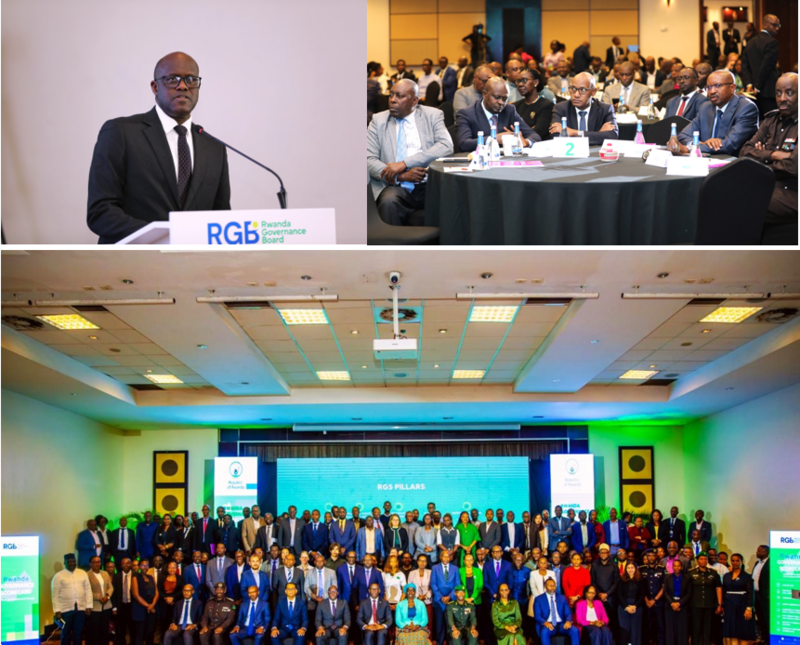
Kigali on Thursday 22nd October 2026-Rwanda governance Board (2025) launched the Rwanda Governance Scorecard 13th edition. The event which took place at Kigali Serena Hotel and brought together participants from diverse backgrounds including diplomats, government officials, academics, civil society organisations, members of parliament, media representatives, and other different development partners.
Particularly this year, the 13th Rwanda Governance Scorecard was launch alongside the Chandler Good Government Index where Chandler Governance Group (CGG) presented the findings and insights of the Chandler Good Government Index (CGGI) 2026 on Rwanda and Africa.
Through the MoU between RGB and CGG, both institutions agreed to work together to advance knowledge exchange, capacity building, research, policy dialogue, and the sharing of best practices in governance and public sector performance. This launch is part of that effort.
The 13th Edition of the RGS draws on national governance data and comparative insights from international indices, including the CGGI, to present a clearer view of how Rwanda performs at home and in comparison, with the rest of the world.
The Chandler Good Government Index is an annual index measuring the capabilities and effectiveness of national governments. The 2026 edition covers 133 countries, representing 94% of the world’s population, across seven pillars and 35 indicators. In 2026, Rwanda ranks 62nd of 133 countries overall, and is the highest-ranked of the Index’s 13 low-income countries.
The Chandler Good Government Index indicates that Rwanda ranks 11th globally for Leadership and Foresight, and first in Africa. Within this pillar, it is 2nd in the world for Long-Term Vision and 3rd for Adaptability, ahead of countries such as the United States and Switzerland.
“Data must drive governance. Tools like our Governance Scorecard, Citizen Report Card, and indeed the Chandler Good Government Index, are not shelf reports. Together, these sources strengthen evidence‑based decision making, improve monitoring, and enhance accountability. It also guides cabinet priorities and budget,” said Dr. Doris Uwicyeza Picard the CEO of Rwanda Governance Board
“Rwanda shows that income alone does not decide how well a government performs. Its Long-Term Vision and Adaptability results in the CGGI are among the strongest in the world. Setting the RGS’s national context beside international benchmarks, as this launch does, supports governments in identifying gaps and setting priorities to deliver better outcomes for citizens,” said Dinesh Naidu, Director (Knowledge), Chandler Governance Group.
The performance of pillars
Safety and Security (90.15%)
Rule of Law (85.47%)
Political Rights and Civil Liberties (81.56%)
Participation and Inclusiveness (84.72%)
Investing in Human and Social Development (68.55%)
Anti-Corruption, Transparency and Accountability (85.80%)
Quality of Service Delivery (68.48%)
Economic and Corporate Governance (73.28%)
In his closing remarks, the Minister of Local Government Hon. Dominique Habimana saluted the RGB leadership and all researchers, institutions and data experts who contributed to the production of the Rwanda Governance Scorecard 13th edition.
“Overall governance performance has remained stable, with five of the eight pillars scoring above 80%. This shows that Rwanda’s institutions continue to be strong, resilient, and trusted by the people they serve” he said.
“This Scorecard allows us to celebrate progress without complacency. It shows us where to focus, where coordination must improve, where implementation must be stronger, and where resources must be used more effectively” he added.
About Rwanda Governance Scorecard (RGS)
The Rwanda Governance Scorecard (RGS) is a national index published by the Rwanda Governance Board (RGB) to consistently assess the state of governance in Rwanda. RGS’s main objectives are to generate credible and reliable information on governance, and to serve as an evidence-based source of data to inform policy formulation, decision-making, and implementation